
A rotary potentiometer is used when a controller needs a continuous angle value from a turning shaft. You see it behind operator knobs and dials, on valve and damper linkages, and on adjustment shafts where the machine must return to the same setting shift after shift. The output can be straightforward, but the result depends on the mechanical connection, the power and ground reference at the controller, and a short set of checks that confirm the reading returns to the same value after cycling.
ETI Systems treats rotary position sensing as one connected path from the shaft to the controller input. That approach keeps attention on the items that decide repeatability, including rotation range, coupling stability, alignment, wiring layout, and a documented baseline at install. The sections below break down where these sensors are used in industry and what design choices prevent drift, noise, and inconsistent setpoints.
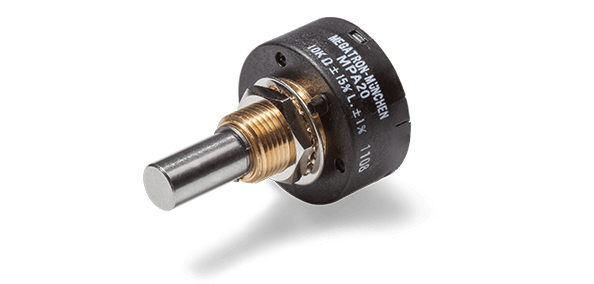
The controller is not “reading the knob,” it is reading a voltage that represents shaft angle. As you turn the shaft, the output voltage shifts in the same direction and by a similar amount, which is what lets the system respond to small movements and hold an in-between setting. That is why this style of feedback is used for trims and setpoints that operators adjust during a shift, where a small turn should produce a small, repeatable change in machine behavior.
That relationship only holds when the shaft angle and the voltage stay tied together. If the coupler slips even slightly, the same physical angle lands on a different voltage, so the operator has to keep chasing the setting. If the power or ground reference at the controller changes under load, the voltage can move even when the shaft is still, which looks like drift. These issues show up as a dial position that will not repeat, a valve or damper that will not stay at a chosen opening, or a setpoint that needs constant correction. For a simple explanation of how the sensing method works, read Rotary Potentiometer Working Principle.
Industrial designs use rotary angle feedback when the machine has to hold a setting between two limits, not just reach an end stop. Operator controls are a common example because a knob position becomes the instruction the controller follows, whether that means holding a steady speed trim, matching a flow setting, or returning a process to the same dial position after a changeover. You also see it in linkages where the shaft position represents a physical opening, like a damper or valve, because the controller can compare the target angle to the current angle and keep the mechanism where it was set.
The value shows up in repeatability. If an operator returns a dial to the same mark, the machine should react the same way, and if a valve returns to the same opening, the process should land on the same result. That consistency is what reduces constant re-adjustment during a shift and keeps setups easier to repeat across operators. If you want a broader overview of product types and selection paths.
Start by matching the sensor’s usable angle to the mechanism’s working angle, then leave a small buffer on both ends so the mechanism never drives the sensor into its electrical limits. If you run into the end of the electrical range, the last portion of travel gets crowded into a smaller output change, which makes fine control harder near the limit and can shift your scaling during setup. A practical way to confirm the fit is to mark the mechanism’s physical end stops, rotate from stop to stop by hand, and check that the sensor still has unused range left at both ends when the mechanism hits its own limits.
Coupling matters because it decides whether the angle and output stay locked together over time. Choose a coupler that holds rotation without slipping, and that can tolerate small misalignment without bending the sensor shaft, then set it up so the coupling grips a flat, a key, or a clamping surface instead of relying on friction alone. After tightening, add a simple witness mark across the coupler and shaft, cycle the mechanism through its full movement, and confirm the mark stays aligned. Then return to one known angle from both directions and confirm the reading lands on the same value each time, because that repeatability check catches slip and backlash before you tune the machine.
Mount the sensor so the shaft stays centered and the mechanism turns it without pushing or pulling sideways. When a linkage forces the shaft off center, the feel becomes rough, the reading can land on a slightly different value after each cycle, and the number can change depending on whether you approach the angle from one direction or the other. A practical way to prevent this is to let the mechanism carry the load and let the sensor only report the angle. Use a proper bracket or panel mount, keep the shaft and coupling aligned, and choose a coupler that can absorb small misalignment without bending the shaft. After assembly, rotate through the full range by hand and confirm the motion stays smooth with no tight spots.
On the wiring side, treat the output like a sensitive signal, because small electrical changes can look like shaft movement at the controller. Route the signal cable away from motor and solenoid power lines, add strain relief so the connector is not carrying pull force, and keep terminations tight so contact resistance does not wander over time. Use shielding when switching loads are nearby and terminate it the way your controller expects, then make sure the sensor and controller share the same power and ground reference. A quick confirmation step is to hold the shaft at one fixed angle and switch nearby loads on and off, because a stable installation keeps the reading steady instead of jumping.
Start setup by turning through the full usable range and watching the reading change smoothly, then pause at a few points and confirm the value holds steady instead of wandering. Move slowly near each end and look for the same change per small turn, because a reading that suddenly flattens, bunches up, or jumps near the limits usually means the mechanism is forcing the sensor, the coupling is shifting, or the power and ground reference is moving when other loads switch.
Next, pick one known angle and approach it from both directions, because a difference between “coming from the left” and “coming from the right” is one of the fastest ways to spot a mechanical issue. Cycle the mechanism several times and confirm that the same angle lands on the same number each time, then record your minimum, maximum, and one mid position value as a baseline for service checks. If a future check fails, you can isolate whether the linkage moved, the coupling loosened, or the electrical reference changed before spending time adjusting control response.
A rotary angle sensor is used to provide a continuous position value for a rotating input such as a knob, dial, valve stem, or linkage.
Drift usually comes from coupling movement, mounting misalignment that changes shaft loading, or power and ground changes at the controller reference.
Choose a range that covers the full working rotation with a small buffer, then confirm the linkage reaches its mechanical limits without forcing the sensor.
Keep signal wires away from high current lines, use shielding when switching loads are nearby, and share the same power and ground reference as the controller.
Record the minimum value, maximum value, and one mid position value, then confirm the same angle returns to the same reading after cycling.