
If you are choosing a control interface for equipment that sees high duty cycles, a Hall Effect Joystick is often the option that keeps the signal steady without relying on sliding electrical contact. In day-to-day operation, that shows up as smoother low-speed control, less need to keep widening the deadband, and fewer surprises when dust, vibration, and temperature swings are part of the job.
ETI Systems supports control designs where the joystick is treated as a measurement device, not just a handle. That means paying attention to the output behavior near the center, how the signal tracks across the full throw, and how the installation affects noise and drift once the joystick is in the cab. The sections below walk through the sensing method, what it changes in real systems, and how to select and commission it so your control feel stays consistent.
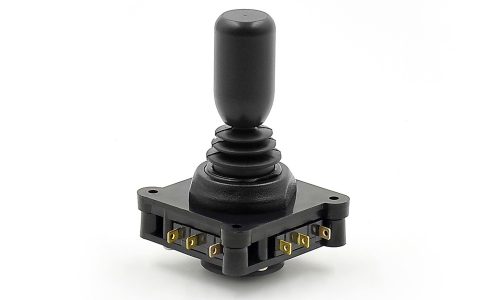
A Hall joystick uses a magnet and sensor to read position, then converts that magnetic field change into an electrical output that the controller can interpret as direction and travel. The important detail is not just that it is “magnetic,” but that the output can be engineered to behave predictably across the full range, including the neutral zone where operators make the most micro corrections. That is where you want a smooth slope, minimal hysteresis, and repeatable return to center so the machine does not feel jumpy.
When you are comparing joystick options, look at what the controller actually receives. Many systems prefer a ratiometric output referenced to the same supply as the controller’s ADC, because it keeps scaling stable if the supply moves slightly under load. In higher consequence equipment, you may also see dual outputs or dual channel sensing with plausibility checks, because redundancy is easier to validate when both channels track the same motion with a known offset. If you want a deeper foundation on the technology itself, read Hall Effect Joystick.
Most field complaints show up as jitter near the center, extra deadband added to hide noise, or a control loop that needs heavier filtering to stay stable. Those are not cosmetic issues because they directly affect operator confidence and cycle time. If the output near neutral is noisy or inconsistent, the machine feels twitchy during inching and alignment, and tuning gets pushed toward smoothing rather than responsiveness.
Hall sensing helps because the signal does not depend on a wiper touching a resistive element, but long-term performance still comes down to design and integration details. Pay attention to center repeatability, output smoothness during slow travel, and stability across temperature, then pair that with wiring discipline so the signal stays clean in a real harness. Practical steps include a stable reference, a solid grounding strategy, and shielding that is continuous from the joystick to the controller input. For a more technical view of what magnetics change in a control path, read Hall Effect Joystick: A Magnetic Approach to Control.
The best use cases are the ones where the joystick is used continuously, and where small movements matter as much as full stroke moves. In mobile hydraulics, lift and position control, and material handling, a joystick that stays consistent helps the machine feel predictable across shifts, operators, and seasons. That is also where maintenance time has a real cost, because calibration and downtime do not scale well as fleets grow.
In these Hall Effect Joystick Applications, value comes from keeping both feel and measurement stable. You want a neutral zone that remains repeatable, a signal that does not wander when the electrical system is busy, and an output curve that matches the task so the operator can feather motion without fighting the machine. When those pieces are right, you can tune the system with smaller deadbands and less filtering, which usually improves response without sacrificing control.
Joystick selection usually begins after operators report extra deadband, twitchy starts, or noticeably different response left versus right. One direction responds differently than the other, fine alignment takes too much effort, or reversing direction creates a lag that operators learn to compensate for. Those are the moments where signal integrity and mechanical feel meet, because even a small amount of noise or center drift shows up immediately in the operator’s hands.
A strong joystick choice matches the application in three ways. First, the mechanics should fit the task, including centering force, throw, handle ergonomics, and sealing needs for the environment. Second, the output should fit the control architecture, whether that is analog voltage, ratiometric scaling, PWM, or a digital interface, because integration choices affect noise sensitivity and diagnostics. Third, the installation should be planned early, with harness routing, grounding, and shielding treated as part of the product, not an afterthought.
A joystick can look perfect on the bench, then feel different once it is installed with a long harness, shared power, and real electrical noise. If the output shifts when other loads switch on, or if the neutral point is not repeatable after cycling, operators notice it immediately as jumpy starts, inconsistent inching, or a machine that feels different from one day to the next. These symptoms are rarely solved by software alone if the underlying reference and wiring behavior are not stable.
Start commissioning by recording a baseline sweep for each axis from center to full travel and back, then log min, max, and return to center after repeated cycles. Next, test slow movements near neutral and confirm the output changes smoothly rather than stepping, then repeat the same checks with the engine running and major loads active. If you see movement in the baseline under load, isolate supply reference, grounding paths, and shielding continuity before you tune response, because tuning cannot fix a moving measurement. For roadmap level planning and what is coming next in joystick design, read Navigating the Future with Hall Effect Joysticks.
It reads position through a magnetic field change, so the signal does not rely on a sliding electrical contact. That often helps output behavior stay more consistent over long duty cycles.
Mobile hydraulics, lift and position control, and material handling are common, especially when inching control and repeatability near neutral matter.
Center repeatability, hysteresis around neutral, output smoothness during slow travel, and stability across temperature are usually the most revealing.
A stable reference, thoughtful grounding, continuous shielding, and harness routing away from high current switching sources are the basics that prevent most issues.
Yes. A recorded baseline sweep with min, max, and return to center values gives you a fast way to spot drift, wiring changes, or reference problems during service.