
Modern manufacturing depends on industrial automation to deliver consistent quality, predictable throughput, and safe operation at scale. From material handling and motion control to sensing, actuation, and supervisory control, automation systems replace manual variability with repeatable logic that can be measured, tuned, and audited. Understanding how these systems work together is the foundation for building production lines that meet performance targets without constant intervention.
At a practical level, industrial automation is not a single technology. It is a coordinated stack of control hardware, field devices, software platforms, and communication layers that translate real-world motion and process variables into digital decisions. When these systems are selected and integrated with discipline, teams reduce downtime, simplify commissioning, and create operations that scale without redesign.
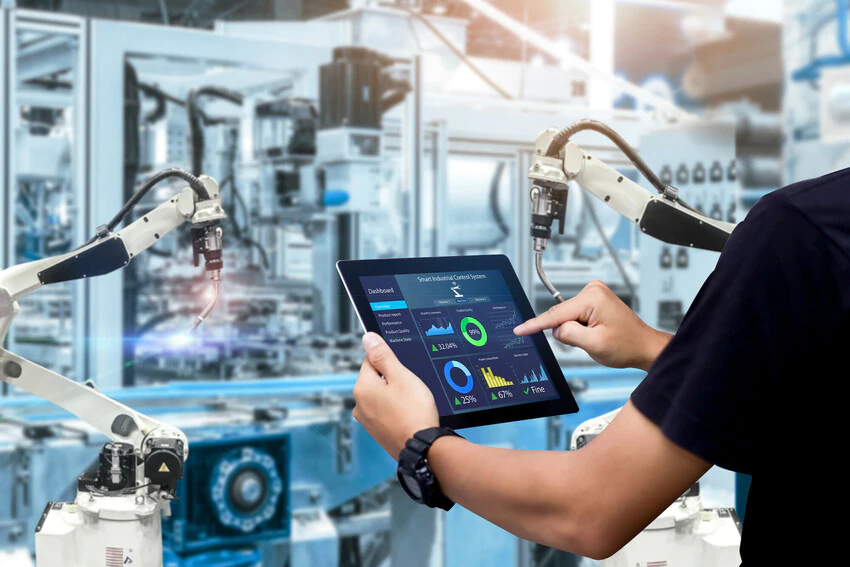
At the core of any automated process is a control system that interprets inputs, executes logic, and drives outputs with precision.
PLCs are the day-to-day control brain on the factory floor. They take in signals from sensors, run the control logic on a fixed scan, and then drive outputs to motors, valves, and other actuators. Because they live next to real machines, PLCs are built to handle electrical noise, vibration, and temperature swings without losing their timing.
Good PLC programs are also written for the people who maintain them. Clear machine states, consistent naming, and simple fault handling make it easier to find what changed when something stops. That usually means faster troubleshooting, safer restarts, and less downtime during a busy shift.
In large continuous processes such as chemical production or power generation, a DCS coordinates control across multiple subsystems. Rather than centralizing all logic, a DCS distributes intelligence closer to the process while maintaining a unified supervisory layer. This architecture improves fault tolerance and simplifies scaling when new units are added to an existing plant.
Safety controllers run alongside the main control logic and step in when something becomes unsafe. They watch inputs like emergency stops, light curtains, gate interlocks, and safe torque off, then force the machine into a safe state when needed. Because they protect people and equipment, they are built around fail-safe behavior, known response times, and documented testing and validation to meet safety requirements.
Automation systems depend on accurate, repeatable feedback from the physical world. Field devices provide this link.
Sensors measure things like position, pressure, temperature, flow, and proximity. A transducer turns that physical change into an electrical signal that the controller can read. Good sensor selection is mostly fit and signal quality: choose the right measurement range and resolution, confirm the device can survive the environment, and make sure the output type matches your input card. When the sensor is a near match instead of the right match, you usually see it as noisy readings, drift over time, and unstable control behavior.
Actuators translate control signals into physical movement. Electric actuators, hydraulic cylinders, and pneumatic devices each serve specific roles based on force, speed, and duty cycle. Matching actuator capability to load conditions prevents overheating, premature wear, and unpredictable motion under peak demand.
Joysticks, pedals, pushbuttons, and touch interfaces allow human operators to interact with machines. These devices must provide a consistent feel, predictable output, and long service life. In mobile or harsh environments, sealing, redundancy, and non-contact sensing improve reliability and reduce maintenance.
Where movement accuracy defines product quality, motion control systems play a critical role.
Drives shape how a motor accelerates, holds speed, and slows down under load. A VFD is a good fit when you need smooth speed control, while a servo drive is used when you need tight position and torque control. Size the drive and motor for the real duty cycle so heat stays under control and the motion stays stable.
Feedback is what keeps motion consistent day to day. Encoders are common when you need a precise digital position, and potentiometers are often used when a strong analog position signal is the goal. When the feedback type matches the drive and the load, the controller corrects small errors quickly, and repeatability improves.
Position feedback works best when the signal uses the input range well. Map mechanical travel to the usable electrical span so the controller sees small moves without struggling. If scaling is too tight, you lose resolution. If it is too aggressive, noise shows up as motion.
Keep scaling simple and test it during commissioning. Set clear endpoints, then check a few known positions and record the readings as a baseline. When scaling is right, tuning goes faster, alarms are easier to trust, and troubleshooting becomes a clean comparison to known good data.
In multi-axis equipment, the controller has to keep axes moving together on the same timing. This is common in packaging lines, robots, and material handling, where one axis drifting can ruin the cycle. Good coordination also reduces vibration because the machine is not fighting itself.
Plan coordination around what the process needs, then verify it under real load. Check that moves start and finish together, and that acceleration does not create spikes that stress belts, couplers, or gearboxes. When axes stay in sync, motion is smoother, parts last longer, and the line can run faster with fewer stops.
Automation relies on reliable data exchange between controllers, devices, and supervisory systems.
Protocols such as EtherNet/IP, PROFINET, and Modbus connect devices with deterministic timing. Network design considers bandwidth, latency, and redundancy to maintain control integrity even when segments fail. Clear addressing and documentation reduce integration errors during expansion.
Signals only help if they stay clean from the device to the controller. Electrical noise, weak grounding, and poor shielding can distort readings and interrupt communication. Keep power and signal runs separated, use shielded cable where it matters, and confirm the grounding plan during commissioning so the system stays stable when the machine is actually running.
Real-time control keeps equipment moving. Supervisory systems add a layer that helps people run the process with less guesswork. They bring alarms, trends, and status into a shared view so operators, maintenance, and engineering can see what the line is doing right now and what it did leading up to a stop. When that visibility is reliable, teams respond faster and make changes with more confidence.
HMIs are the screens operators use to run the line. The most useful HMIs focus on decisions: what is in alarm, what step the machine is in, and what the operator should check next. Clear labels, consistent page layouts, and a small set of well-chosen trends help operators understand whether the issue is a sensor signal, a motion limit, a timing problem, or a material condition, without digging through dozens of screens.
SCADA pulls data from PLCs and remote assets into one place so teams can monitor performance across shifts and sites. It is where alarm history, time-stamped events, and long-term trends come together, which is valuable for finding repeat problems and verifying that a tuning change or setpoint update actually helped. When SCADA tags are consistent and time synchronization is handled well, the data becomes a practical tool for uptime, not just a dashboard.
MES links the shop floor to production planning and quality tracking. It records orders, counts, downtime reasons, and key checks. When MES is connected to control data, teams gain traceability that supports audits and continuous improvement without adding extra manual work.
Efficiency improves when you design automation around the full workflow, from how material enters the line to how the product exits and gets verified. If you want a focused walkthrough on where efficiency gains come from and how teams sustain them, use the internal resource Power of Industrial Automation for Efficient Operations. When the controls, devices, motion behavior, and data reporting all point to the same targets, the process settles down. You see steadier cycle times, fewer quality surprises, and quicker changeovers because recipes, limits, and setpoints are documented and repeatable across shifts.
Maintainability is what keeps those gains from fading. Standardized parts and consistent wiring make troubleshooting faster, and good diagnostics help teams find the real cause instead of guessing. If you also save baseline checks like a simple sweep, step response, or repeatability read, technicians can compare today to known good behavior after service. That makes recovery more predictable and keeps the line running without constant manual intervention.
A strong startup is important, but long-term uptime is decided by how well you validate the system and how easy it is to support.
When parts arrive, do a short acceptance check before they go into a build. Record basics like a baseline sweep or step response, repeatability, and noise in the working range. Save the results under the exact part number so future troubleshooting is faster and more consistent.
Heat, vibration, moisture, and chemicals all shorten component life. Design for the real environment and the real duty cycle, including peak loads. When thermal limits and sealing are handled early, you avoid the failures that show up only after weeks of production.
Parts change over time, so plan for it. Keep approved alternates that match the mechanical fit and the signal behavior, and standardize mounting where you can. Stock service spares for critical points and include a simple post-replacement check so field swaps are quick and controlled.
When you treat automation as a connected system, the payoff is bigger than one machine running faster. For a deeper system-level framework and how teams structure the stack end to end, see the internal guide Industrial Automation Systems: Unleashing the Power of Industrial Automation Systems. Coordinated control, reliable data flow, and consistent standards help plants scale, add new products, and keep quality steady as volumes change.
The practical path is discipline: clear specifications, quick verification, and lifecycle planning that includes documentation and spares. With those basics in place, automation stays flexible without becoming complicated.
Turn requirements into a dependable system by writing down what matters, selecting parts that truly fit, and verifying performance before you scale.
Write the requirements in plain terms. Include motion range, expected response time, safety functions, and the electrical interfaces you will use. When the I/O types and signal ranges match your controller from day one, integration goes faster, and changes are easier to control.
Choose components using datasheets and environmental ratings that reflect the real install. Then confirm the basics with a small evaluation order. A quick fit check and a simple acceptance test usually catch near matches before they become rework.
Install with clean wiring, correct grounding, and a network layout that is easy to troubleshoot. Commission under real load, not just on a bench, and record baseline readings so you have a reference for future service.
Standardize parts and connectors where you can, so swaps are simple. Keep clear documentation, store baseline results, and give technicians a short, repeatable check they can run after maintenance to confirm the machine is back in spec.
Most projects combine control systems, field devices, motion components, communication networks, and supervisory software. Each layer serves a distinct role while supporting the overall process.
Controllers interpret sensor inputs and execute logic, then command actuators to move or regulate processes. Accurate feedback ensures actions match intent.
Precise motion directly affects product quality and throughput. Properly sized drives and reliable feedback reduce variability and mechanical stress.
Industrial networks enable deterministic communication between devices. Good design prevents data loss and simplifies expansion.
By documenting requirements, running acceptance tests, storing baselines, and planning for lifecycle changes, teams maintain stability and reduce downtime.