
When we choose position feedback, we are deciding how the controller will “see” the mechanism during every cycle. The real requirement is a position value that stays stable under vibration, temperature change, and electrical noise while motors and drives are running.
When that value is stable, we can set limits with confidence, tune motion without chasing jitter, and diagnose problems by comparing today’s readings to a known baseline. When it is not stable, teams lose time because the signal itself becomes the variable, and every adjustment turns into trial and error.
A strong Potentiometer Application starts with the way the mechanism moves and the way the controller reads the signal. We look at the usable working range, mounting alignment, and how noise can enter the wiring when motors and drives are active. Once those details are handled, potentiometer feedback becomes a simple, reliable way to confirm position and support repeatable control.
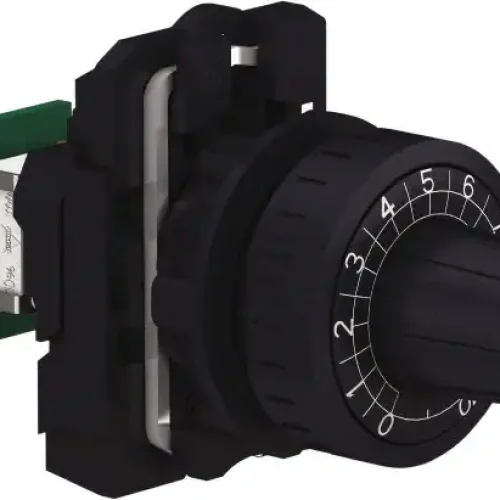
We commonly see potentiometer feedback on cylinders, slides, guided actuators, and valve linkages, where straight travel needs more than an on or off confirmation. The value comes from continuous position information, which lets the control program set limits, check travel, and detect drift between cycles.
The results depend heavily on mechanics. If the sensor is side-loaded or the linkage introduces play, the controller sees jitter that looks like movement. When we build the mounting to stay aligned, and we keep the working band away from electrical endpoints, the signal remains smoother, and the machine stays easier to keep in tolerance.
Rotary potentiometers are a common fit when the mechanism turns through a defined window and returns to repeatable endpoints. You will see this in dampers, flow control linkages, operator handles, and rotary selectors where the control system needs a proportional command rather than a simple switch state.
In these setups, we pay attention to scaling and endpoints early because most problems come from using too little of the electrical range or riding too close to a stop. If you want a deeper selection breakdown for limited-angle designs, our next read is Single Turn Potentiometers Applications and Options.
Potentiometers are also widely used where a person is the control loop. Handles, pedals, and manual adjusters often rely on a stable proportional signal so the machine responds smoothly to small movements. The goal is a predictable feel that does not change from shift to shift.
In operator controls, signal quality matters most around neutral and during slow movement. That is where small electrical noise can feel like creep or unintended command. We typically protect this by planning wiring routes, grounding, and strain relief so the signal remains steady while the machine is running.
A reliable Potentiometer Application is easier to support when commissioning ends with a short baseline. We record scaled endpoints, confirm smooth output through the working band, and save one or two repeatable position checks that represent normal operation. Those notes become the reference during service.
When a part is replaced later, technicians can run the same checks and compare results to the original baseline. If the reading changed, they can quickly separate mounting shift and wiring noise from true sensor wear. If you want a broader view of how different potentiometer types fit common industrial tasks, a useful guide is Understanding Potentiometers: Types, Uses, and Industrial Applications.
We choose the sensor style after we define the motion, the usable range, and the environment. Straight travel points toward linear feedback. Limited rotation points toward a rotary sensor that can be scaled cleanly inside the working window. From there, we confirm the controller input behavior so the signal is read correctly under real load and electrical noise.
If you want a deeper, step-by-step selection and installation walkthrough, our next read is Potentiometer. We use the same thinking on every project because it keeps selection grounded in real operation and makes verification repeatable across builds.
We work with engineers who need feedback that stays stable after commissioning and remains measurable during service. Our selection process starts with how the mechanism moves, how sensitive the control loop is to small changes, and what installation details can influence signal quality. That approach helps us avoid configurations that look fine on paper but become noisy or unstable once the machine is running.
We also support teams with practical verification steps that fit real maintenance windows. A good Potentiometer Application is one that can be checked quickly with recorded baselines, so troubleshooting stays focused on measurable readings instead of repeated tuning. When those baselines are part of the build record, support becomes faster and long-term performance stays more predictable.
A potentiometer is used to convert motion into a proportional electrical signal so the controller can read position, set limits, and confirm repeatable movement.
They are commonly applied in linear position feedback, limited-angle rotary control, and operator input devices where proportional command improves control behavior.
Start with the motion type and usable working range, then confirm mounting alignment and controller input behavior so the signal remains stable under real conditions.
Misalignment, mechanical play, and wiring practices near high-current paths can introduce noise that looks like movement, especially when the machine is operating.
Record scaled endpoints, confirm smooth output through the working band, and save one or two repeatable readings so future service can verify the same Potentiometer Application quickly.
